

Safety Standards
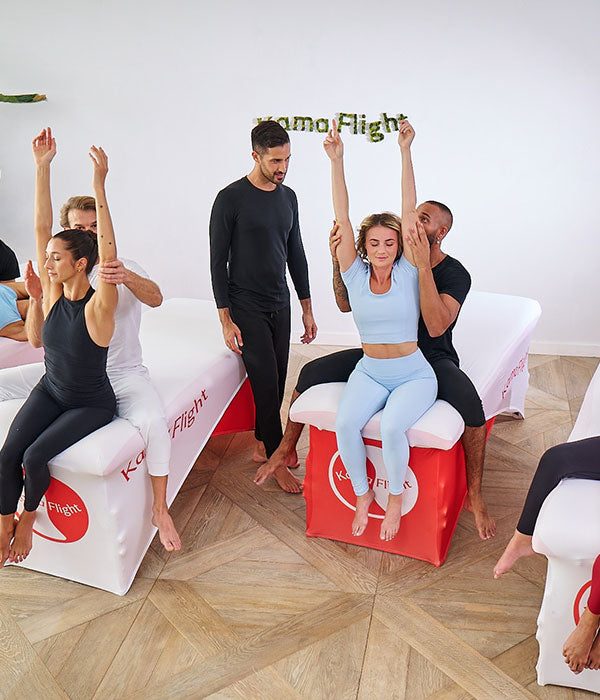
Kama Flight Foundation is a registered 501(c)(3) nonprofit dedicated to relational wellness, communication, trust, and human connection through evidence-informed partnered movement education. Every class, workshop, retreat, and Teacher Training we run is built around one non-negotiable idea: the container has to be safe before it can be playful. This page explains how we build that safety into every session — for attendees, instructors, and the studio owners who host us — and links out to the detailed standards behind it.
Our Four Principles
Everything we teach — and everything on this page — is grounded in four principles. They're taught on day one of every Teacher Training and repeated in every class:
Full attention on your own body and your partner's, moment to moment. Presence is what lets you notice a real "yes" or "no" instead of an assumed one.
Explicit, ongoing consent for every touch and transition. Nothing is assumed, and any moment can be paused or renegotiated — by either partner.
The complementary roles of Base (grounded, guiding) and Voyager (receptive, expressive) that give every partnered sequence its structure — roles anyone can practice, regardless of gender.
Curiosity and lightness, on purpose. Play lowers defensiveness and is part of why partnered movement practices are associated with bonding and stress-relief responses in the nervous system (see research below).
Every Session Is Held By These Standards
- Certified teachers only. Every Kama Flight and Kama Floor class is led by an instructor who has completed our YACEP-registered Teacher Training, including a dedicated module on trauma sensitivity and safety.
- No-fly zones. The chest, inner thighs, and buttocks are off-limits in every sequence we teach, in every format — Class, Workshop, or Jam.
- Structured check-ins. Instructors pause the room at set points in every session to ask how partners are doing, and either partner can initiate a check-in at any time.
- Defined, swappable roles. Base and Voyager are taught as skills, not identities — every participant is invited to practice both over time.
- Session-length guidance. A typical partnered exchange runs 5–15 minutes, and we recommend no more than 90 minutes of practice in a single day without breaks.
- Health disclosure, every time. Participants are asked to tell their instructor about any injury, condition, or physical limitation before a session begins, so movements can be modified.
Explore Our Safety Standards
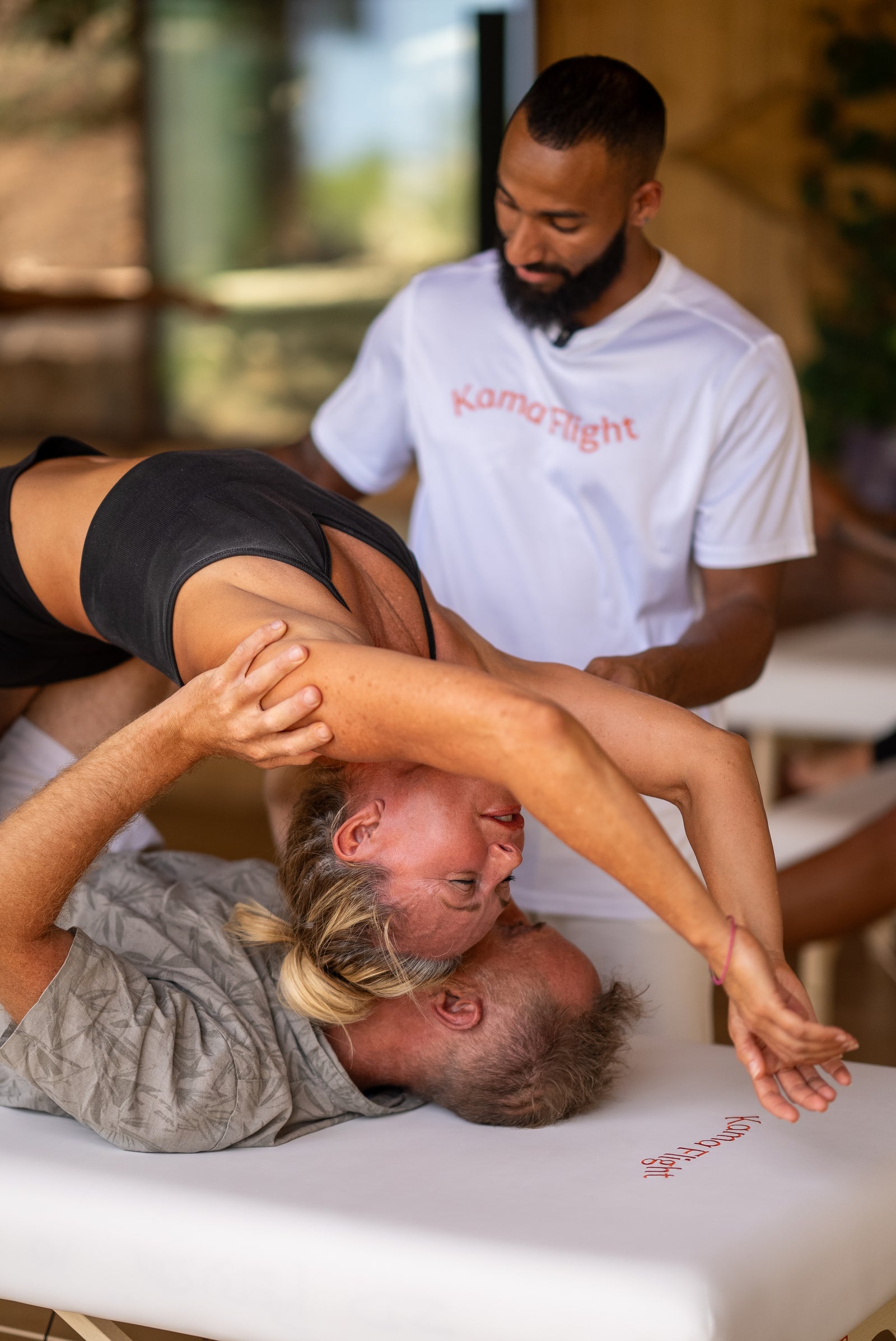
Each of these pages goes deeper into one part of how we hold a safe container. If you're preparing for your first class, training to teach, or bringing Kama Flight into your studio, start here:
Behavior standards for attendees, instructors, and studio partners.
How consent is asked for, given, and revoked — at any point, for any reason.
Clothing guidance so movement stays controlled, comfortable, and safe.
Health considerations, contraindications, and how we modify practice.
Certification, training, and the supervision every instructor commits to.
How we hold space for nervous-system safety, not just physical safety.
Who This Is For
Kama Flight is designed for adult couples, friends, and movement lovers 21 and older — no prior yoga or dance experience required, and welcoming to all identities and orientations. It's also built for the instructors and independent studio owners who bring it into their communities. Kama Flight is a wellness and connection practice; it is not a substitute for medical care or mental health treatment, and we encourage anyone with a physical or psychological condition to consult a qualified provider before beginning.
Have a concern during a session or event?
Speak directly with your facilitator — every certified Kama Flight teacher is trained to hold a safe container and respond to boundary concerns in real time. You can also reach our support team any time at support@kamaflight.com, or visit our Contact page.
The Research Behind Our Approach
Kama Flight's safety standards are built on Presence, Permission, Polarity, and Play, and on a growing body of research into how touch, play, and partnered movement affect the nervous system:
- Curtis, J.T., Liu, Y., Aragona, B.J., & Wang, Z. (2006). Dopamine and monogamy. Brain Research, 1126(1), 76–90. pubmed.ncbi.nlm.nih.gov/16950234
- Vrtička, P., & Vuilleumier, P. (2012). Neuroscience of human social interactions and adult attachment style. Frontiers in Human Neuroscience, 6, 212. pubmed.ncbi.nlm.nih.gov/22822396
- Stein, D.J., & Vythilingum, B. (2009). Love and attachment: the psychobiology of social bonding. CNS Spectrums, 14(5), 239–242. pubmed.ncbi.nlm.nih.gov/19407722
- Bernaerts, S., Prinsen, J., Berra, E., Bosmans, G., Steyaert, J., & Alaerts, K. (2017). Long-term oxytocin administration enhances the experience of attachment. Psychoneuroendocrinology, 78, 1–9. pubmed.ncbi.nlm.nih.gov/28131072
- Substance Abuse and Mental Health Services Administration (SAMHSA). Trauma and Violence. samhsa.gov/mental-health/trauma-violence — general background on trauma-informed care; see our Trauma-Sensitive Practice page for how we apply it.
These citations describe the general neuroscience of bonding, touch, and attachment that informs our approach. They are not clinical claims about Kama Flight specifically.
